When it comes to protecting your business, one of the most important decisions is choosing the right locking system. Business owners often face a critical choice: Key Code Lock vs Mechanical Lock. Both options offer unique security features, but which one truly provides the safest protection for your business assets, employees, and sensitive information?
In this guide, we will explore Key Code Lock vs Mechanical Lock, comparing their advantages, disadvantages, security features, and practical considerations to help you make the most informed decision for your business.
Key Code Lock vs Mechanical Lock: What You Need to Know
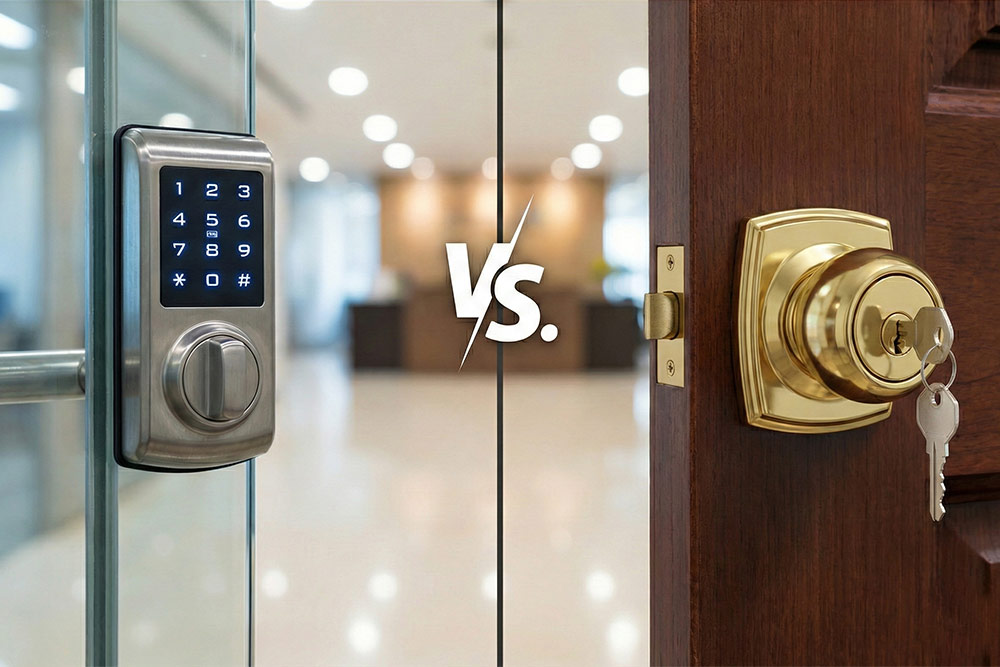
A key code lock, also known as an electronic or digital lock, is a type of locking mechanism that requires a numeric or alphanumeric code to gain entry. Unlike traditional locks, no physical key is needed. Users input a pre-set code to unlock the door, offering flexibility and control.
How Key Code Locks Work
Key code locks operate using electronic circuits or microprocessors. When a user enters the correct code, the mechanism triggers the lock to open. Some advanced models may also integrate with access control systems, allowing for audit trails, temporary access codes, and remote locking/unlocking.
Advantages of Key Code Locks for Businesses
- Keyless Access: No need for physical keys reduces the risk of lost or stolen keys.
- Access Management: Administrators can easily grant or revoke access for employees, contractors, or visitors.
- Audit Trails: Many models log entry times, helping monitor who accessed the premises and when.
- Temporary Access Codes: Perfect for temporary staff, deliveries, or maintenance personnel.
- Integration with Security Systems: Can be connected with CCTV, alarms, or building management systems.
Disadvantages of Key Code Locks
- Power Dependency: Many key code locks require batteries or electricity. A dead battery or power failure can prevent access.
- Code Vulnerability: Codes can be guessed, shared, or observed by unauthorized personnel.
- Higher Initial Cost: Electronic locks often cost more upfront than traditional mechanical locks.
- Technical Malfunctions: As with any electronic device, there is a risk of software or hardware failure.
What is a Mechanical Lock?
A mechanical lock is the traditional lock that relies on a physical key to operate. Mechanical locks range from simple pin-and-tumbler designs to complex high-security models used in commercial buildings.
How Mechanical Locks Work
Mechanical locks operate purely through physical components. The key aligns pins or tumblers inside the lock, allowing the cylinder to turn and the door to open. Unlike key code locks, they do not rely on electronics, batteries, or codes.
Advantages of Mechanical Locks
- Reliability: Mechanical locks are durable and work without power or electronics.
- Lower Cost: Typically cheaper to install and maintain than key code locks.
- Simplicity: Easy to use, without requiring technical knowledge.
- Proven Security: Mechanical locks have been refined over centuries and are familiar to locksmiths for quick servicing or repair.
Disadvantages of Mechanical Locks
- Key Management Issues: Lost or stolen keys can compromise security, and rekeying is necessary.
- Limited Access Control: Unlike key code locks, you cannot easily monitor who enters or exits.
- Vulnerability to Picking: Mechanical locks can be picked or bumped by experienced intruders.
- Inconvenience for Large Teams: Managing multiple keys for employees can be cumbersome.
Types of Key Code Locks for Businesses
Not all key code locks are created equal. Understanding the different types can help businesses choose the right level of security and functionality.
1. Standalone Keypad Locks
These are self-contained units installed on a door. They are ideal for offices, storage rooms, or small commercial properties. Features include:
-
Easy installation
-
Battery-operated systems
-
Simple programming for multiple codes
2. Networked or Smart Key Code Locks
These locks connect to a network or cloud system, allowing remote management. Ideal for larger businesses or facilities with multiple entry points, they offer:
-
Remote locking/unlocking
-
Time-restricted access for staff
-
Integration with security cameras and alarms
3. Biometric Key Code Locks
Some key code locks combine numeric codes with biometric authentication, such as fingerprints or facial recognition, for an added layer of security. These are ideal for highly sensitive areas, like data centers or executive offices.
Types of Mechanical Locks
Mechanical locks also vary in complexity and security level. Knowing the differences can help businesses select the right solution.
1. Standard Pin-and-Tumbler Locks
The most common type, suitable for general office doors or low-risk areas. Features include:
-
Affordable and reliable
-
Easy to replace or rekey
-
Vulnerable to picking if not high-security
2. High-Security Mechanical Locks
These locks have features like:
-
Anti-pick pins
-
Drill-resistant components
-
Restricted keyways
-
Patented key control to prevent unauthorized duplication
3. Deadbolts
Deadbolts provide extra protection for exterior doors and high-risk entry points. They are often combined with standard mechanical locks for layered security.
Comparing Security Features: Key Code Lock vs Mechanical Lock
When deciding between a key code lock vs mechanical lock, it is essential to examine how each performs in real-world security scenarios.
Key Code Lock vs Mechanical Lock: Access Control
- Key Code Lock: Offers superior access control. Codes can be customized for individual users, and access can be granted or revoked instantly.
- Mechanical Lock: Access is limited to key holders. Losing control of keys can create vulnerabilities.
Key Code Lock vs Mechanical Lock: Audit and Monitoring
- Key Code Lock: Electronic locks can track entries, provide reports, and send alerts.
- Mechanical Lock: No monitoring capabilities exist; there’s no way to know who accessed a door at a specific time.
Key Code Lock vs Mechanical Lock: Resistance to Tampering
- Key Code Lock: While difficult to pick, key code locks are vulnerable to hacking or code sharing if proper protocols are not enforced.
- Mechanical Lock: Susceptible to picking, bumping, or forced entry but immune to digital hacking.
Key Code Lock vs Mechanical Lock: Reliability Comparison
- Key Code Lock: Relies on batteries or power. Malfunctions can lock out users if not properly maintained.
- Mechanical Lock: Extremely reliable; works in all conditions without needing electricity.
Practical Considerations for Businesses: Key Code Lock vs Mechanical Lock
Choosing between a key code lock vs mechanical lock depends not only on security but also on practical considerations unique to your business environment.
Key Code Lock vs Mechanical Lock: Business Size and Workforce
- Small businesses with a handful of employees may find mechanical locks sufficient, as key management is simpler.
- Medium to large businesses benefit more from key code locks, where access needs to be controlled and monitored across multiple staff members and departments.
Key Code Lock vs Mechanical Lock: Location and Environment
- Mechanical locks are ideal for locations with unreliable electricity or harsh environments where electronics could fail.
- Key code locks are suitable for offices, retail stores, and modern commercial buildings where access control and monitoring are priorities.
Key Code Lock vs Mechanical Lock: Cost and Maintenance
- Mechanical locks are cheaper upfront and require minimal maintenance, mostly lubrication and occasional key duplication.
- Key code locks involve higher upfront costs, periodic battery replacement, and potential software updates. However, they reduce the cost and hassle of rekeying locks when keys are lost.
Key Code Lock vs Mechanical Lock: Real-World Examples
Example 1: Retail Store
A retail chain implemented key code locks on its storage rooms to monitor inventory access. Employees were given unique codes, allowing management to track who accessed the storage areas and when. The electronic locks reduced incidents of internal theft and made it easier to grant temporary access to contractors.
Example 2: Small Law Office
A small law office relied on mechanical locks for its office doors. With only a few employees, key management was simple. The reliability of mechanical locks meant there were no worries about power failures or technical malfunctions disrupting access.
Example 3: Warehouse Facility
A large warehouse with multiple entry points adopted a hybrid approach: key code locks for main entry gates and mechanical locks for internal storage rooms. This strategy balanced high-tech monitoring for sensitive areas with the reliability of mechanical locks for low-risk sections.
Key Code Lock vs Mechanical Lock: Which is Safer?
The answer is not one-size-fits-all. Safety depends on context:
- Key Code Locks offer enhanced control, monitoring, and flexibility. For businesses where auditing access and managing large teams are critical, they provide higher overall security.
- Mechanical Locks excel in reliability, simplicity, and protection against electronic hacking. For small businesses or areas where technical issues could compromise access, mechanical locks remain a solid choice.
Combining the Best of Both Worlds
Many businesses opt for a hybrid security strategy, combining key code locks with mechanical locks. This approach provides:
- Backup Security: Mechanical locks serve as a fail-safe if electronics fail.
- Layered Protection: Combining digital access control with traditional locks increases overall security.
- Flexible Access Management: Key code locks allow dynamic access for temporary staff while mechanical locks secure sensitive or low-traffic areas.
Tips to Maximize Security with Key Code Lock vs Mechanical Lock
Whether you choose a key code lock, mechanical lock, or a combination, following these tips enhances safety:
For Key Code Locks
- Change codes regularly and avoid predictable combinations.
- Limit the number of people with access to critical codes.
- Monitor audit logs to detect unauthorized attempts.
- Keep the lock software updated if it supports firmware updates.
For Mechanical Locks
- Use high-security, pick-resistant lock models.
- Rekey locks immediately if a key is lost or an employee leaves.
- Consider master key systems for better key management in large businesses.
- Regularly inspect and maintain locks to ensure smooth operation.
Conclusion
Choosing between a key code lock vs mechanical lock ultimately depends on the specific needs of your business.
- Key code locks excel in modern security features, access control, and monitoring, making them ideal for medium to large businesses or locations with high employee turnover.
- Mechanical locks provide dependable, low-maintenance security that has stood the test of time, suitable for small businesses or areas where electronic solutions are impractical.
Many businesses find that a hybrid approach offers the most comprehensive protection, combining the convenience and control of key code locks with the reliability and simplicity of mechanical locks.
Investing in the right locking system ensures peace of mind, protects your assets, and maintains the trust of clients and employees. At 777 Locksmith Services, we carefully weigh your operational needs, security risks, and budget to make the safest choice for your business